
Gondolas in Venice: History, Secrets, and What Tourists Should Really Know
- Ristorante Riva Rialto
- Jan 10
- 2 min read
Introduction
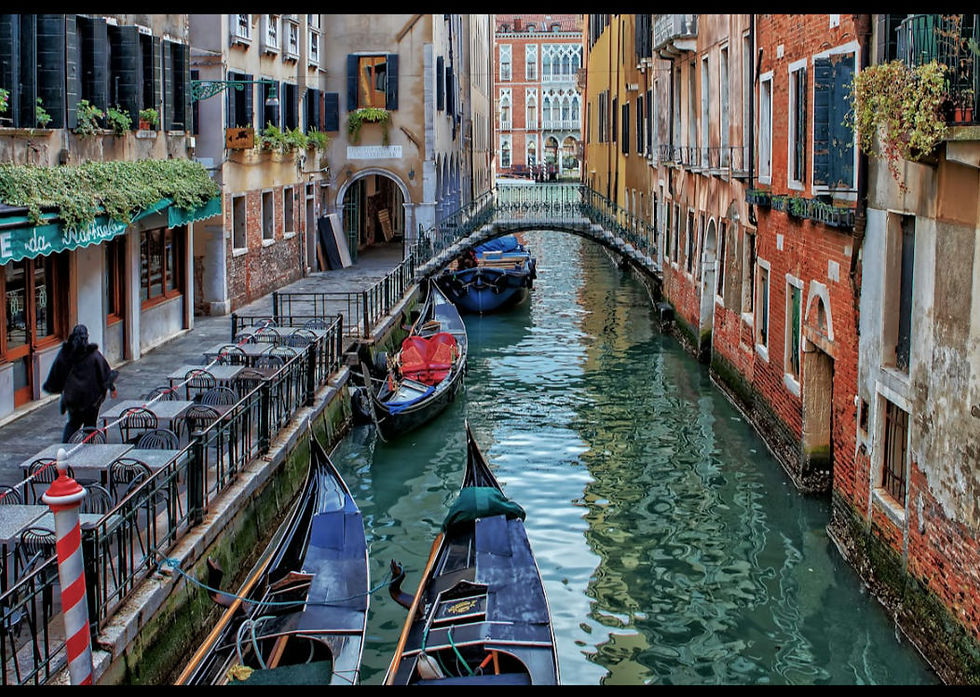
No image represents Venice better than a gondola gliding silently through a canal. For visitors, it is the ultimate symbol of romance and tradition. But gondolas are far more than a tourist attraction—they are a living piece of Venetian history, shaped by centuries of laws, craftsmanship, and daily life.
Understanding their story adds depth to the experience and reveals why gondolas are so unique.
The Origins of the Gondola
Gondolas have existed in Venice for over a thousand years. The first written references date back to the 11th century, when they were the main means of transportation for nobles, merchants, and officials.
Before bridges connected the city, gondolas functioned like modern taxis, ambulances, and delivery vehicles. Every Venetian family relied on them to move through the lagoon.
Why Are Gondolas Black?
One of the most common questions tourists ask is why all gondolas are black. The reason lies in Venetian law, not aesthetics.
During the Renaissance, gondolas were lavishly decorated to show wealth and power. To stop excessive competition among noble families, the Venetian Republic imposed strict rules, requiring gondolas to be painted black.
Over time, black became a symbol of elegance, simplicity, and balance—values deeply rooted in Venetian culture.
A Perfectly Asymmetrical Boat
At first glance, gondolas appear symmetrical, but they are not. They are intentionally asymmetrical, leaning slightly to one side to compensate for the gondolier rowing with a single oar.
This design allows gondolas to move straight through narrow canals and make sharp turns with precision. Every curve serves a practical purpose refined over centuries.
The Meaning of the Ferro
The metal piece at the front of the gondola, called the ferro, is rich in symbolism. Its six forward-facing teeth represent the six historic districts (sestieri) of Venice.
The backward-facing tooth symbolizes Giudecca, while the curved shape mirrors the outline of the Grand Canal. Even decoration in Venice tells a story.
Gondoliers: Guardians of Tradition
Becoming a gondolier is not easy. Licenses are limited and often passed down through families. Gondoliers must undergo years of training, learning:
Venetian rowing techniques
Navigation through canals
Local history and etiquette
The iconic striped shirt is not mandatory, but it has become a recognizable symbol of the profession.
Gondolas Today: Tradition Meets Tourism
While gondolas are no longer essential for daily transport, they remain active in ceremonial events, weddings, and regattas.
For tourists, a gondola ride offers a rare perspective of Venice—quiet canals, hidden courtyards, and views impossible to see on foot. The experience is less about speed and more about atmosphere.
Are Gondola Rides Worth It?
Many visitors wonder if gondola rides are worth the price. While not inexpensive, they are a once-in-a-lifetime experience tied directly to Venetian heritage.
For a more authentic feel, rides through smaller canals away from the Grand Canal offer a quieter and more intimate atmosphere.
Conclusion
Gondolas are not just boats—they are floating history. Every detail, from their shape to their color, reflects centuries of Venetian ingenuity and tradition.
To ride a gondola is not simply to take a tour, but to experience Venice the way it has moved for generations.
👌


La ricerca indica che l'inquadramento rimane equo ed equilibrato nel complesso. Le affermazioni comportamentali sono legate a dati concreti di supporto. Il sito web contiene contesto tematico complementare per la questione. Le traiettorie di adozione sono illustrate tramite ecosistemi multimediali basati su piattaforme.